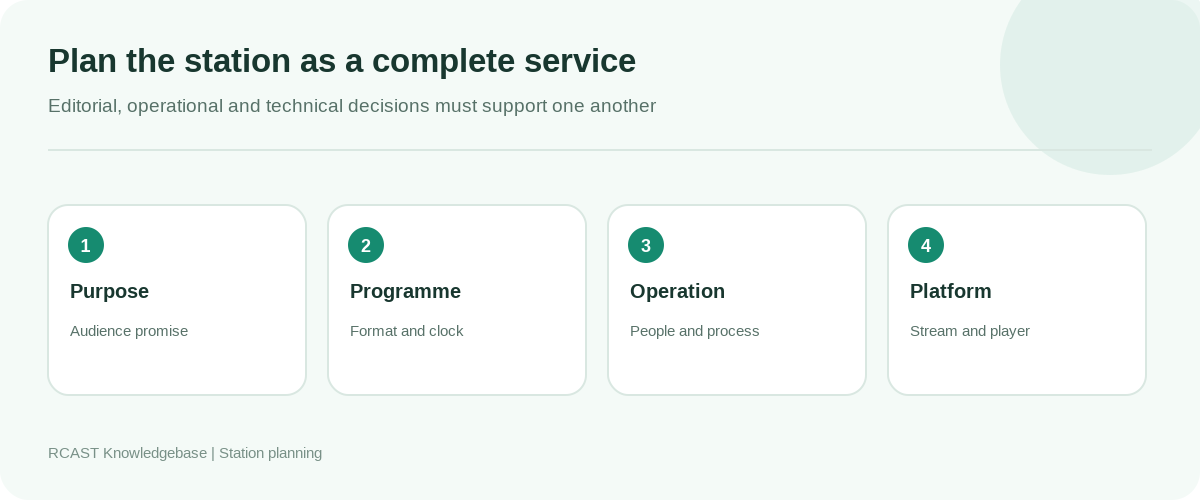
A successful internet radio station is designed before it is promoted. The stream, schedule, presenters, music rights, website and operating procedures must support the same audience promise. This guide turns an initial idea into a practical launch plan, with decisions and test gates that reduce expensive changes after listeners arrive.
Write a clear purpose
Begin with one sentence explaining who the station serves, what it provides and why a listener would choose it. “A radio station for everyone” is too broad to guide programming. “Independent electronic music and local event coverage for listeners in Bristol” suggests content, contributors, tone and distribution.
Decide whether the station is commercial, community based, educational, promotional or a personal creative project. That choice affects governance, music licensing, advertising, safeguarding, finances and the amount of continuity required. Record the purpose in a short project brief that every contributor can understand.
Define the target listener
Describe listening situations rather than inventing a vague demographic. Consider location, language, interests, devices, time of day and expected session length. A commuter using mobile data has different needs from a listener playing a specialist show through a home system.
Speak with potential listeners before building the full schedule. Ask what they currently use, what is missing, when they listen and which programmes they would return for. Treat compliments about the idea as weaker evidence than actual listening behaviour.
Choose the programming model
A live station offers immediacy and interaction but requires dependable staffing. AutoDJ provides continuity and controlled rotations. A hybrid combines scheduled automation with live shows and is often the most practical starting model. Define exactly how live takeover and return to automation will work.
| Model | Strength | Planning requirement |
|---|---|---|
| Live led | Personality, events and interaction | Presenter cover and resilient studios |
| AutoDJ led | Consistent continuous service | Large prepared library and schedule maintenance |
| Hybrid | Continuity plus appointment listening | Reliable handover procedures |
| Pop up or seasonal | Focused campaign or event | Clear opening, closing and archive plan |
Do not promise a 24 hour staffed service when the team can support only a few shows. A smaller reliable schedule with good automation sounds more professional than empty live slots and repeated cancellations.
Design the format and weekly schedule
Define the balance of music, speech, news, advertising, specialist programmes and station imaging. Build a representative hour before attempting an entire week. Mark fixed commitments, then identify where flexible rotations can supply variety.
Create a weekly grid that reflects listener availability and presenter capacity. Repeat or rebroadcast specialist programmes deliberately rather than leaving gaps. Include production and maintenance time. Every scheduled programme needs an owner, delivery method, expected duration and replacement plan.
Calculate a realistic content requirement
A music format needs enough prepared material to avoid obvious repetition. Estimate how many songs play per hour, category sizes and intended separation. Add station IDs, promos, legal identification, features and advertising. Spoken programmes require research, booking, editing and compliance time that is easy to underestimate.
Define acceptance standards for audio files, metadata, artwork and programme delivery. A shared folder of inconsistent filenames is not a library. Assign responsibility for reviewing new material before it enters automation.
Research licensing and legal responsibilities
Streaming technology does not grant rights to music, recordings, artwork or syndicated programmes. Identify the territories served, content used and organisations responsible for licences and reporting. Requirements vary by country, organisation and business model, so obtain current advice from the relevant licensing bodies or a qualified professional.
Plan privacy notices, website cookies, competition rules, advertising standards and retention of listener information. Stations involving children or vulnerable contributors need appropriate safeguarding procedures. Keep rights and permissions with the programme records.
Build the operating team
List the roles required even when one person initially performs several of them: station manager, programme lead, technical owner, music scheduler, producer, presenter, website editor, sales or fundraising, and listener support. Define who can approve a schedule change, reset credentials and speak for the station during an incident.
Create onboarding and offboarding checklists. Give people named accounts and only the access their role needs. Establish editorial rules, expected conduct, file deadlines and absence reporting before disagreements occur.
Create a practical budget
Separate setup costs from recurring costs. Include streaming, domain, website, licensing, music acquisition, microphones, interfaces, headphones, acoustic work, automation software, design, insurance, marketing and replacement equipment. Add a contingency for damaged cables, failed computers and price changes.
Forecast income conservatively. Sponsorship and advertising normally require an audience and sales effort; they should not be assumed merely because the stream launches. Decide how long the station can operate without income and who authorises spending.
Select the technical architecture
Draw the route from programme source to listener. Identify studio or automation software, encoder, RCAST service, public HTTPS stream, website player, metadata and directories. Decide the codec and bitrate based on content, compatibility, mobile data use and available listener capacity.
Plan failure behaviour. If a live presenter disconnects, should AutoDJ return? If the automation computer stops, is there a fallback playlist? If the website fails, can listeners still use a direct player? Simplicity is valuable at launch. Add extra stream qualities and complex routing after the primary service is stable.
Estimate capacity and connectivity
Choose a listener limit that matches realistic launch activity and promotional events. Source upload requires a stable connection with headroom. The studio should use wired Ethernet where practical and avoid relying on headline speed alone. Test sustained upload stability during the hours when programmes will run.
List the devices and browsers listeners are likely to use. Verify HTTPS playback, mobile background behaviour and accessibility. A technically online server is not useful if the intended audience cannot start the player.
Create the station identity
Check that the proposed name is distinctive and that suitable domains and social handles can be controlled. Research relevant trademarks before investing in artwork. Design a logo that remains legible as a small square icon, and define colours, typography and tone of voice.
Produce only the imaging required for the pilot first: a primary station ID, short sweeper, show promo and fallback announcement. Excessive imaging can make a new schedule sound repetitive. Keep project files and document voices, music and usage permissions.
Write operating procedures
Create concise instructions for starting a live show, checking the public return, updating metadata, handling silence, ending a show and reporting faults. Add contact routes and escalation thresholds. Procedures should work for a trained presenter under pressure, not only for the engineer who designed the system.
Maintain a programme log and change record. Document the known working encoder settings without exposing passwords. Keep emergency material and a backup connection method ready.
Run a private pilot
- Operate the complete schedule privately for several days.
- Use live presenters, AutoDJ, metadata, player and fallback exactly as planned.
- Listen from different networks and devices.
- Record silence, disconnects, incorrect metadata and missed programme starts.
- Collect structured feedback from a small test group.
- Fix the causes and repeat the affected test.
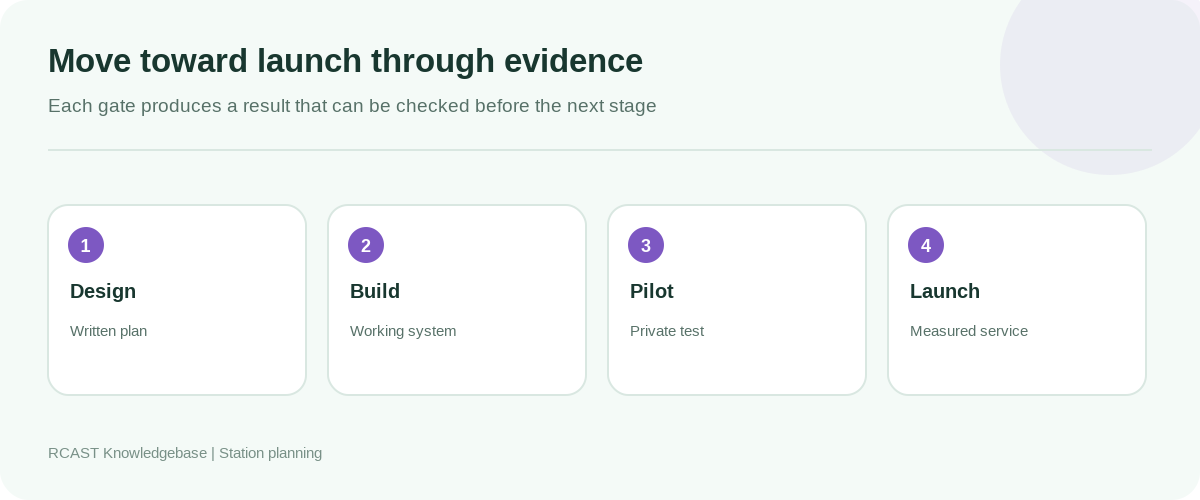
The pilot should include ordinary operation, not only a short demonstration. Leave automation running overnight. Test a late presenter, corrupt file, internet interruption and handover between live and automated programming.
Prepare the public launch
Choose a launch date only after the pilot meets defined criteria. Prepare the website, schedule, listening instructions, privacy information and contact address. Submit directory listings early enough for review but do not depend on every directory approving the station by launch day.
Create a promotional plan with specific messages and audiences. Explain what listeners will hear and when, rather than repeatedly saying that a station is coming soon. Give presenters approved artwork and links so public information remains consistent.
Define launch acceptance criteria
| Area | Example acceptance test |
|---|---|
| Audio | No clipping, silence or channel fault during a representative day |
| Continuity | Live disconnect returns to the intended fallback |
| Player | Starts on target desktop and mobile browsers over HTTPS |
| Metadata | Music and programme labels update correctly |
| Operations | Presenters complete start and end procedures unaided |
| Recovery | Authorised staff can restore the essential service |
Measure the first 90 days
Track uptime, listening sessions, average time, peak demand, programme completion, website behaviour and direct listener feedback. Compare trends rather than celebrating one peak created by a launch post. Review which programmes are reliable, which discovery channels produce sustained listening and where people abandon the player.
Hold short operational reviews after the first week, first month and third month. Fix reliability and scheduling before adding many new shows. Preserve the central station promise while adapting tactics based on evidence.
Common planning mistakes
Buying equipment before defining the workflow
Equipment choices should follow the number of presenters, room, routing and operating model.
Launching with an empty schedule
Publicity creates only a first visit. Listeners need predictable reasons to return.
Depending on one person
Document access and procedures so illness or departure does not stop the station.
Adding too many platforms at once
Commission the primary stream, player and schedule first. Expand distribution from a stable base.
Frequently asked questions
How long should planning take?
It depends on scope, but a pilot should run long enough to exercise the real weekly workflow. A rushed public date is not evidence of readiness.
Can one person launch a station?
Yes, particularly with AutoDJ, but the schedule and support promise should match that person's sustainable capacity.
Should the station stream continuously before launch?
A private continuous pilot is useful for testing automation and stability. Public promotion should wait until the service is intentional and supported.
A strong launch plan connects audience, programming, people, rights, finances and technology. Write the decisions down, build the smallest complete service, test it under realistic conditions and launch only when the evidence shows that listeners will receive the promised experience.